Nansen is a good tool. It's just not built for what most perp traders need.
If you're trading Hyperliquid perpetuals and you're trying to figure out when to enter a trade, Nansen doesn't answer that question. It answers a different one: who is holding what. Those are genuinely different problems, and conflating them is why a lot of traders end up paying $49/month for something that never quite fits.
This isn't a hit piece on Nansen. It's a breakdown of what the tool actually does, where it stops for perp traders, and what a Hyperliquid-native alternative looks like.
What Nansen actually gives you
Nansen labels wallets. That's the core product.
It has tagged 300 million+ wallets across 30+ chains, including a "Smart Money" cohort of roughly 10,000 wallets belonging to VCs, hedge funds, and historically profitable traders. You can see what those wallets are holding, what they've recently bought or sold, and how on-chain flows are moving between protocols.
For the use cases it's built for, this is genuinely useful. Token due diligence, DeFi research, protocol adoption tracking, identifying accumulation patterns before a launch. If you're an institutional investor or a researcher trying to understand on-chain behavior, Nansen is a serious tool.
The pricing reflects that audience. The Pro plan is $49/month billed annually, or $69/month on a monthly basis. At that price point, you're paying for institutional-grade on-chain intelligence. That's what you get.
Where it stops for perp traders
Nansen has 8 Hyperliquid API endpoints. But they're generalist wallet snapshots, not exchange-native data. There's a meaningful gap between tracking what a wallet holds and tracking how that wallet is positioned in a live derivatives market.
Specifically, what Nansen doesn't cover for Hyperliquid perp trading:
- Funding rates. No data on whether funding is positive or negative, how far it's pushed, or whether it signals crowded positioning. Understanding how Hyperliquid funding rates work is often the difference between a trade that costs you money while you wait and one that pays you to hold.
- Open interest velocity. Not just current OI, but how fast it's building, in which direction, and whether it's accelerating or stalling. That velocity is a timing signal. Nansen doesn't track it.
- Positioning consensus. What percentage of profitable wallets are long vs. short right now, on a specific coin, on Hyperliquid specifically. Nansen's Smart Money labels are cross-chain generalists. That's not the same as a Hyperliquid-native cohort ranked by directional performance.
- Squeeze risk. Where are the liquidation clusters sitting? What happens to price if it moves 3% against the crowded side? Nansen doesn't model this at all.
- Behavioral cohort classification. Nansen labels wallets statically. A perp trader needs to know how a wallet behaves in the current regime, not just whether it's historically been "smart."
One Trustpilot reviewer put it plainly: Nansen is "best suited for professional investors, hedge funds, whale watchers, not beginners or casual investors." That framing holds. If you're timing short-term perp entries on Hyperliquid, you're not the audience Nansen was designed for.
What a perp trader actually needs
The core need is simple: context at the moment of decision.
Before entering a position, you want to know whether the smart money is already crowded in your direction (and therefore you're late), whether funding is punishing that side (and therefore you're fighting costs), and whether there's a setup where multiple independent high-performers have just converged on the same trade (and therefore something real might be happening).
That's a timing and positioning question, not a research question. Wallet labels don't answer it. Live derivatives data does.
What HyprSwarm shows instead
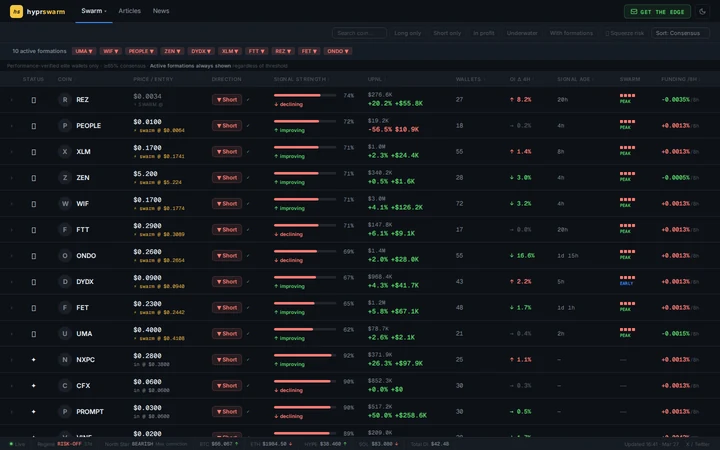
HyprSwarm's Smart Money dashboard tracks Hyperliquid-native wallets rated by directional performance using an ELO system. Wallets get rated based on whether their positions actually worked out, not just whether they've been historically active.
The dashboard shows live positioning consensus: what percentage of elite-rated wallets are long vs. short on each coin right now. That number updates continuously. When it shifts sharply in one direction, you're seeing a behavioral signal, not a historical pattern.
The specific data points covered:
- Swarm formations. When multiple independent high-performers converge on the same direction without coordinating, HyprSwarm flags it as a formation. That's the signal worth paying attention to, because it's not one whale making a call, it's several independently-acting traders reaching the same conclusion.
- Funding rates. Direction and magnitude, so you can see whether you'd be paying or collecting to hold a position.
- OI change. How open interest is moving, not just where it sits.
- Squeeze risk. The Squeeze Radar identifies coins where the crowded side is vulnerable to a forced unwind. Useful both for avoiding bad entries and for identifying setups where a squeeze is the trade.
- Formation age. How long a swarm formation has been active. A fresh formation and a 12-hour-old one carry different risk profiles.
Every signal HyprSwarm generates gets logged to the Proof Wall with verified outcomes. That's how you audit whether the signals hold up over time.
How HyprSwarm works covers the full methodology if you want to understand the ELO system and formation detection in detail.
It's free to use.
Who each tool is actually for
Nansen is for: VCs evaluating a token before investing, DeFi researchers tracking protocol adoption, institutional investors monitoring on-chain flows, and anyone who needs cross-chain wallet intelligence for research purposes. If your question is "what are smart money wallets accumulating this quarter," Nansen answers it.
HyprSwarm is for: Hyperliquid perp traders who want to know what the smart money is positioned in right now, whether funding and OI support or undermine that position, and whether a formation is worth acting on. If your question is "should I be in this trade at this moment," that's the dataset that's relevant.
Neither tool replaces the other, because they're not trying to do the same thing. Nansen is a research layer. HyprSwarm is a timing layer. If you're a perp trader paying $49/month for Nansen and finding it doesn't help you time entries, it's not because Nansen is bad. It's because you're using a research tool for a trading decision.
FAQ
Is Nansen worth it for Hyperliquid perp traders?
Probably not, unless you're doing token due diligence alongside your trading. Nansen covers wallet labels and on-chain flows across 30+ chains, but it has no funding rate data, no OI tracking, and no positioning consensus for Hyperliquid perps. Those gaps matter a lot if timing is the main thing you need.
What does HyprSwarm track that Nansen doesn't?
HyprSwarm tracks live long/short positioning from elite Hyperliquid wallets, funding rate direction, open interest change, squeeze risk, and swarm formations where multiple independent high-performers converge on the same trade. None of that exists in Nansen's Hyperliquid coverage.
Is HyprSwarm free?
Yes. HyprSwarm is free to use. The Smart Money dashboard, Squeeze Radar, heatmap, and per-coin intel pages are all available without a subscription.
HyprSwarm tracks live positioning signals from elite Hyperliquid wallets. This is signal data, not financial advice. Always do your own research before entering any position.